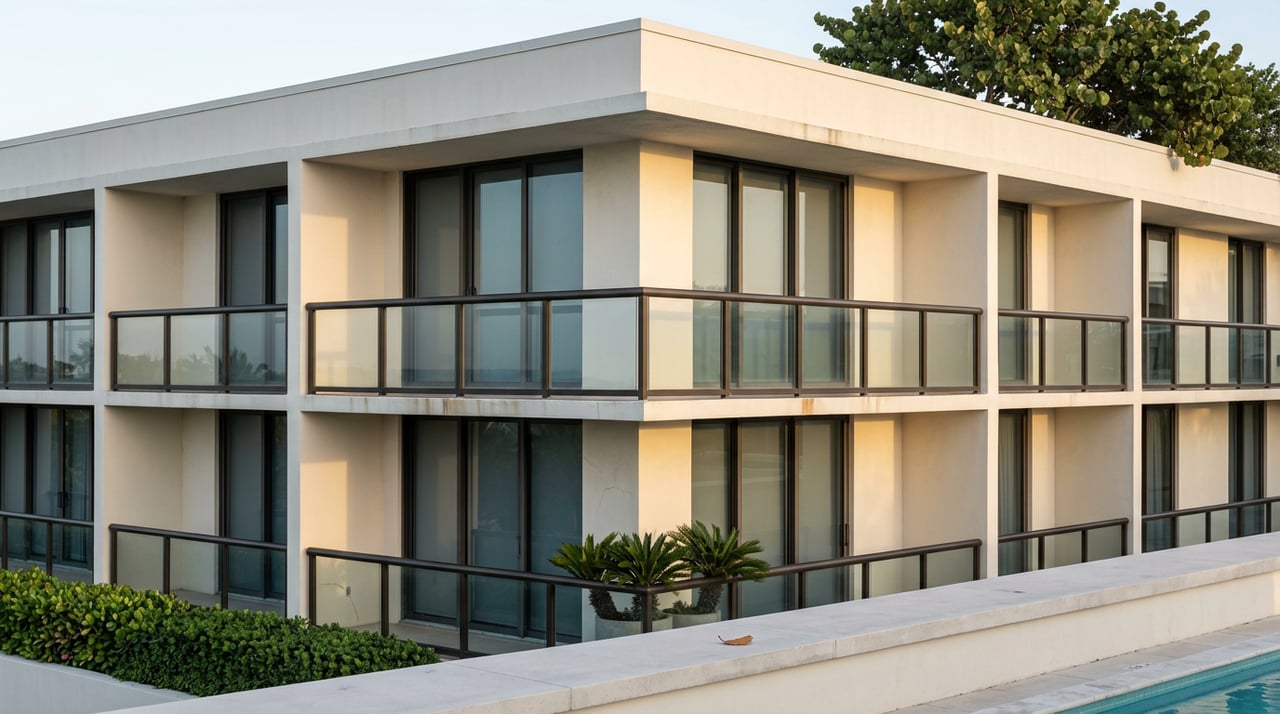
The Real Reason Two Boca Raton Condos Ten Blocks Apart Are Priced $400,000 Apart
August 20, 2026
August 20, 2026
Walk a buyer through a two-bedroom on A1A and a comparable two-bedroom a few blocks inland at Alina, and the price gap will stop them mid-tour. Same square footage, similar finishes, arguably a better view from the older building's higher floor. Yet the newer unit can carry a price tag hundreds of thousands of dollars higher. Ask most agents why, and you'll get an answer about amenities or brand cachet. That's not it, or at least not the whole of it. The real answer sits in a filing cabinet at the condo association's office, and it has a deadline on it.
What separates these two units isn't finish level. It's which side of Florida's structural inspection clock the building sits on. And this quarter, that clock stopped being an abstraction and became a number buyers can actually see.
Florida's milestone inspection law, known as SB 4-D, requires condominium and cooperative buildings three stories or taller to undergo a structural inspection once they hit 30 years of age, or 25 years if they sit within three miles of the coast. After that first inspection, another one follows every 10 years. Alongside it, buildings must complete a Structural Integrity Reserve Study, or SIRS, that prices out the useful life and replacement cost of major structural components and sets a funding schedule for reserves.
The law itself isn't new. It followed the Champlain Towers South collapse in Surfside in 2021 and passed the Florida Legislature in 2022. The general SIRS deadline has already come and gone once, pushed from its original end of 2024 to the end of 2025. What's still live right now is a narrower deadline: for any association whose milestone inspection falls due this year, the state allows the SIRS to run alongside it, but draws a hard line that it cannot be completed after December 31, 2026. That date is four and a half months from today, which means any Boca building turning 25 or 30 in 2026 is working against a real clock this quarter, not a theoretical one.
On August 1, 2026, the Florida Legislature's own watchdog office released its first statewide accounting of how aging condo buildings are holding up under this law, and it flagged more than 2,500 buildings for deeper structural review. That report didn't name every building on that list publicly, but it confirmed what agents working older coastal inventory have watched build for two years: a wave of buildings hitting their 25- or 30-year mark at the same time insurance costs and reserve mandates tightened.
Boca Raton's condo stock didn't arrive all at once, and that's exactly the point. A meaningful share of the city's oceanfront and Intracoastal inventory along A1A and around Camino Real was built in the 1970s, 1980s, and 1990s, long before anyone wrote a milestone inspection statute. Those buildings are the ones working through inspections and reserve studies right now, some for the first time, some for their second round a decade after an earlier local recertification.
Compare that to what's actually opening in Boca this year. Alina Residences, developed by El-Ad National Properties along SE Mizner Boulevard, has effectively sold out its first two towers, Alina 200 and Alina 210, and recorded more than $60 million in recent sales as it moves through its final building, Alina 220. Down the street, Glass House Boca Raton is rising at 280 E. Palmetto Park Road as the city's first all-glass residential tower, a nine-story, 28-unit building with prices ranging from $2.7 million to $8 million, financed in part by a $70 million construction loan and slated for completion in 2027. And in March 2026, Boca Raton's City Council unanimously approved an eight-story, 76-unit condo tower at 501 E. Camino Real on land shared with the Boca Raton Resort & Club, with eight-figure pricing expected for its top units.
None of those buildings will face a first milestone inspection for decades, likely sometime in the 2040s or 2050s depending on delivery date. That's the actual gap a buyer is pricing when they compare a 1980s A1A tower to a brand-new Boca development. It isn't the marble or the smart locks. It's decades of runway before the reserve clock even starts.
None of this means an older Boca condo is a bad buy. Plenty of well-managed associations have already funded their reserves properly and cleared their inspections without drama. The difference between a smart purchase and an expensive surprise comes down to what you ask for before you write an offer, not after.
Before contract, request:
Florida's Condominium Act gives buyers meaningful rights here, including access to association financial records and, in certain circumstances, the ability to cancel a contract if required disclosures aren't delivered in time. Waiting until after you're under contract to ask these questions puts you in a much weaker position than asking before you make an offer.
When a building's inspection and reserve costs converge, boards typically don't finance the gap over years. They call a one-time special assessment, and industry estimates put the range for these anywhere from $10,000 to more than $100,000 per unit, depending on the scope of repair work, the size of the reserve shortfall, and how much insurance premiums have climbed for that specific building.
That's the number that erases the apparent discount on an older unit. A condo priced $400,000 below a comparable new-construction unit stops looking like a deal the moment a $60,000 assessment notice arrives eighteen months into ownership. It's not that the older building is a mistake. It's that the purchase price without the paper trail is an incomplete number, and in a market where more than 2,500 buildings just got flagged statewide, incomplete numbers are exactly what catch buyers off guard.
Does a low HOA fee on an older Boca condo mean it's a good deal? Not on its own. A low fee sometimes means an association has been underfunding reserves for years, which is precisely the pattern the milestone and SIRS laws were written to correct. Ask for the percent-funded figure before assuming a low fee is a benefit.
What's the real difference between the 25-year and 30-year clock? Location. Buildings within three miles of the coast, which covers most of Boca's oceanfront and much of its Intracoastal stock, face the earlier 25-year trigger. Inland buildings get the extra five years.
Will a building like Alina or Glass House ever face this? Eventually, yes, but not for decades. New construction delivered in 2026 or 2027 won't hit its first milestone inspection until it turns 25 or 30, which puts that reckoning somewhere in the 2040s or 2050s.
What if a board hasn't produced a SIRS yet? Ask why, and ask when it's scheduled. With the December 31, 2026 outer deadline now close, an association still without a completed study should be able to tell you exactly where it stands in the process. If they can't, treat that as information in itself.
Whether you're weighing a sun-worn A1A tower against a fresh delivery at Alina or Glass House, the number that matters most isn't on the listing sheet. It's in the association's filing cabinet, and it's worth reading before you fall for the view. John Wilson and Lisa Wilson have spent years walking buyers through exactly these documents on Boca Raton's coastal corridor. Schedule a private consultation before you write your next offer.
Stay up to date on the latest real estate trends.
Experience a bespoke real estate partnership where every detail is considered and every goal prioritized. Working with us means more than a transaction. It’s an elevated journey defined by discretion, expertise, and results tailored to you