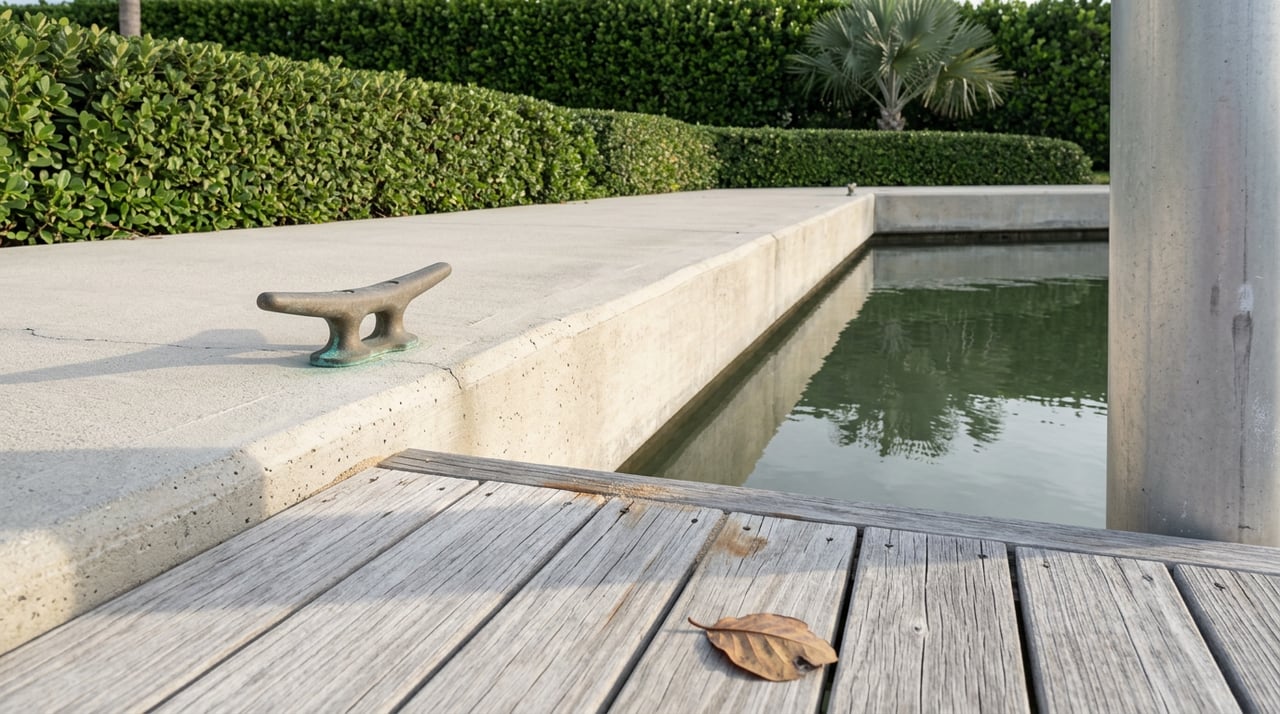
Boca Raton Waterfront Seawall and Dock Diligence
August 27, 2026
August 27, 2026
What actually stalls a waterfront closing in Boca Raton? Ask five agents and four will point to financing or insurance underwriting. The fifth, the one who has closed a deal on a canal lot in Camino Gardens or an Intracoastal estate inside Royal Palm Yacht & Country Club, will tell you it is the wall you can see from the kitchen window.
Not because it is cracked or leaning. Most of the seawalls holding up Boca's waterfront lots look perfectly fine from the dock. The problem is what happens the moment anyone, a buyer's inspector, a title company, an HOA board, needs to confirm that the wall was built the way the paperwork says it was, or that any planned repair can actually get approved before the closing date everyone agreed to. That confirmation runs through more than one bureaucracy at once, and the two don't move on the same clock.
The real risk in a Boca waterfront transaction is not whether the seawall holds water. It is whether anyone can prove it was built to hold water legally, and how many separate approvals stand between a signed contract and a permit in hand.
In gated waterfront communities like Royal Palm Yacht & Country Club, Boca Bay Colony, Camino Gardens, and Harbour East, any dock or seawall work has to clear architectural review from the HOA board on top of standard municipal permitting. Marine contractors who work these neighborhoods regularly describe submitting full design packages to the association, attending board meetings when required, and holding off on any construction until both the HOA sign-off and the government permits are in hand. Neither substitutes for the other.
The government side alone can involve several agencies working in sequence rather than parallel:
A buyer who assumes the seawall is a private matter between the homeowner and a contractor is missing that the wall sits at the intersection of a homeowners association's design standards and at least three layers of government jurisdiction, sometimes four.
Here is the detail that catches people off guard during diligence. Boca Raton's seawall and marine structure standards set a minimum elevation of 4.0 feet NAVD88 for any new or replaced seawall or dock. That threshold does not apply to a wall that is simply repaired in place. It applies the moment a wall is replaced, which means an aging bulkhead that has quietly sat below that elevation for decades is not grandfathered forever. It is grandfathered until the day it needs real work, at which point the owner is not rebuilding the same wall. They are building a different one, to a different standard, under review from both the city and the HOA.
That timing matters because the visible parts of a seawall, the cap, the face, the drainage weep holes, rarely tell the whole story. Structural problems in South Florida seawalls typically develop below the waterline: soil voids from erosion, tie-back failure, rebar corrosion accelerated by saltwater exposure. A wall can look structurally sound from a dock chair and still be a candidate for full replacement once an engineer gets underneath it. The city also limits how far a single-family dock may project waterward of the seawall depending on canal width, which means even a straightforward dock extension can turn into a design conversation with two review boards instead of one.
For a buyer, the practical takeaway is that a seawall's age and appearance tell you almost nothing about what it will cost, or how long it will take, to bring current if it ever needs to be touched.
Much of Boca's Intracoastal frontage sits near designated manatee protection zones, and those zones carry construction timing restrictions that have nothing to do with permits or HOA approval. Pile-driving activity, the step required for most new dock or seawall construction, is restricted during active manatee protection periods. Marine contractors who work these waterways plan around it at the design phase because it directly affects how long a project takes from approval to completion.
A buyer who assumes they can close, then fix the dock over the following few weeks, is assuming a schedule the wall does not control. If the work requires pile driving and the timing falls inside a restricted period, the fix waits, sometimes for months, regardless of how quickly the permits and HOA approval came through.
The clearest evidence that marine infrastructure, not square footage, drives value on this stretch of coast comes from Royal Palm Yacht & Country Club itself. The community's private marina holds 60 slips and accommodates vessels up to 120 feet, staffed by a full-time dockmaster. Annual HOA dues run $4,150 per lot, and the community has never levied a special assessment. According to the Premiere Estate Properties 2026 market report, Royal Palm trades at roughly $2,235 per square foot against a citywide luxury single-family average near $648 per square foot, a premium of about 3.4 times the broader market.
That gap is not paying for finishes. It is paying for deep water behind the house, a functioning yacht club, and dock capacity that most of the county cannot offer. Which means the marine documentation protecting that dock, not the kitchen renovation, is what actually protects the resale premium a buyer is paying for on day one.
For buyers and sellers alike, the paperwork that prevents a stalled closing is specific and gatherable well before a contract is signed:
Sellers who assemble this file before listing remove the single biggest variable a waterfront buyer's team will otherwise have to chase down mid-contract. Buyers who request it on day one of diligence, rather than after an inspector flags a concern, keep leverage over price and timeline instead of losing it.
Does a seawall that looks fine from the dock mean it's structurally sound? Not necessarily. The most common problems, soil voids, tie-back failure, corrosion, develop below the waterline and are not visible from above. An underwater assessment is the only way to confirm condition on an older wall.
Can an owner repair a failing seawall without triggering the new elevation requirement? Repair in place generally does not trigger the 4.0-foot NAVD88 standard. Replacement does. The distinction between a repair and a replacement is often the deciding factor in project cost and timeline.
How long does marine permitting typically take in Boca Raton? It varies with scope. A straightforward repair can move quickly. A new dock or a seawall replacement, especially one requiring HOA review, county and state permits, and possibly Army Corps sign-off, can take months from application to approved construction.
Does every waterfront property in Boca carry this extra HOA layer? Gated communities with private marinas or deeded waterfront, including Royal Palm Yacht & Country Club, Boca Bay Colony, Camino Gardens, and Harbour East, do. Individual canal-front lots outside a formal HOA may only face municipal and state permitting, which is worth confirming property by property.
A waterfront closing in Boca Raton rarely stalls because of the house. It stalls because two separate approval systems, one private and one governmental, have to agree on the same piece of concrete before anyone can act on it. Knowing that going in is the difference between a smooth close and a summer spent waiting on a permit.
If you are evaluating a waterfront property in Boca Raton, or preparing one to list, Wilson Luxury Real Estate can walk you through the diligence that protects your timeline and your price. Schedule a private consultation to start the conversation before you're under contract, not after.
Stay up to date on the latest real estate trends.
Experience a bespoke real estate partnership where every detail is considered and every goal prioritized. Working with us means more than a transaction. It’s an elevated journey defined by discretion, expertise, and results tailored to you